Introducing Rabbit Agentic: Proactive GCP cost optimization in PRs and agents
Kristóf Horváth
7 min read
We’re introducing Rabbit Agentic, a suite of tools and AI workflows that bring Google Cloud cost optimization into your pull requests, IDE, and the coding agents your team already uses. The problem is familiar: waste is often locked in at the IaC and configuration layer long before billing dashboards show it, and higher PR velocity from agent-assisted development makes “merge first, optimize later” the default path. Rabbit Agentic is built to shift optimization left in your team’s workflow, catching cost waste before it ships.
Agentic tools and higher PR velocity have turned code review into the bottleneck for many teams. Reviews routinely cover correctness and security; economics rarely gets the same rigor. Rabbit Agentic adds a cost and performance optimization lane next to those reviews, with concrete, resource-level output instead of hand-wavy “watch your spend” advice.
What are the key feature sets of Rabbit Agentic?
Every capability under Rabbit Agentic draws from the same structured knowledge of Google Cloud pricing patterns, resource relationships, and optimization heuristics that Rabbit has built up over years of GCP optimization for clients. You can think of this new feature set as an experienced GCP optimization architect working 24/7 to review all your PRs and to make sure the agents your teams use deliver optimized configurations only. Meanwhile, for Rabbit users, this architect also automatically opens ready-to-merge optimization PRs implementing the core Rabbit platform’s recommendations.
Cost-focused code review
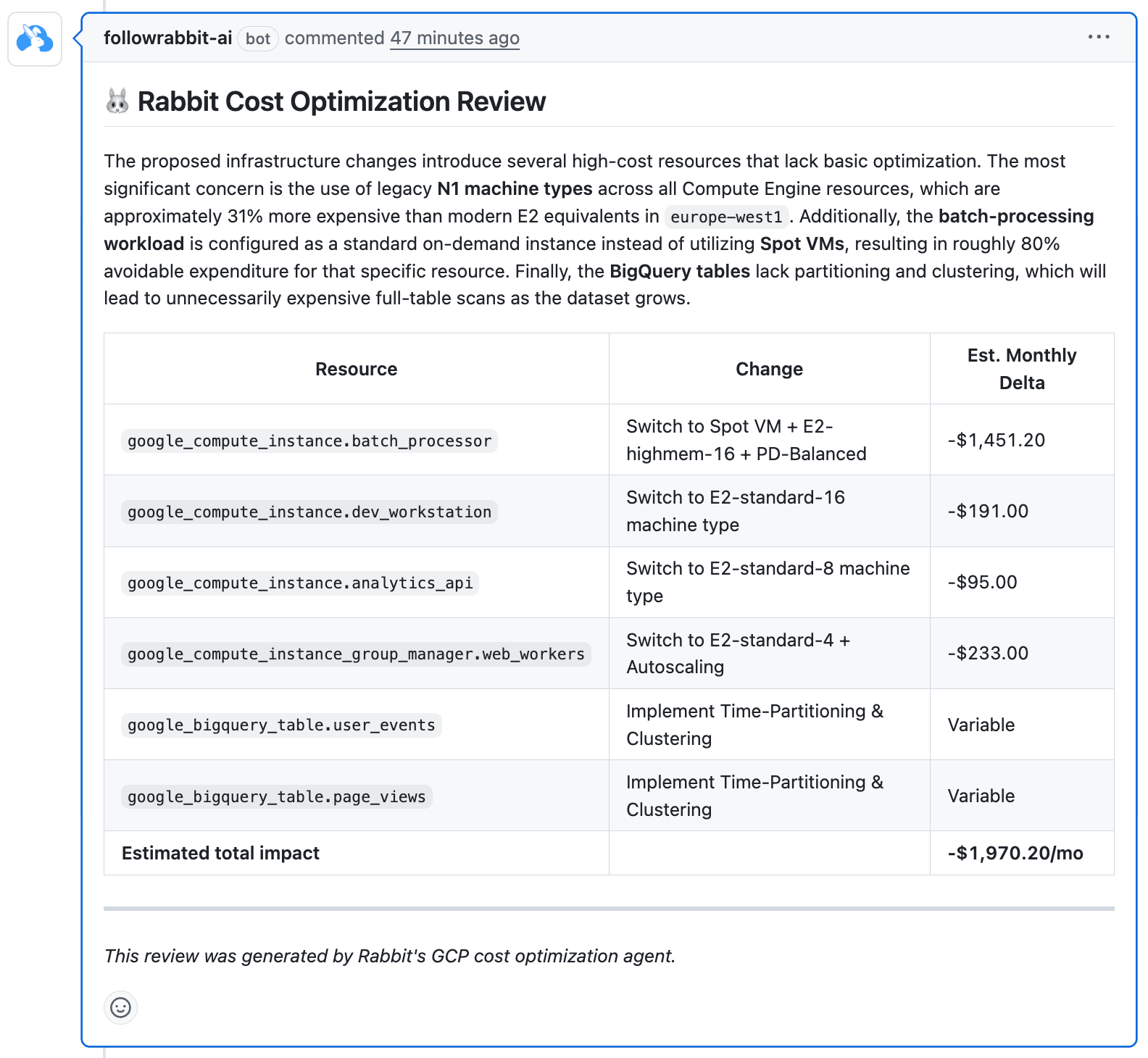
On infrastructure and query pull requests, Rabbit acts as an AI cost reviewer on the diff: inline comments on specific lines, severity-rated findings, and a summary that rolls up estimated cost impact where pricing can be determined. GitHub-native suggestions let reviewers apply fixes with ease.
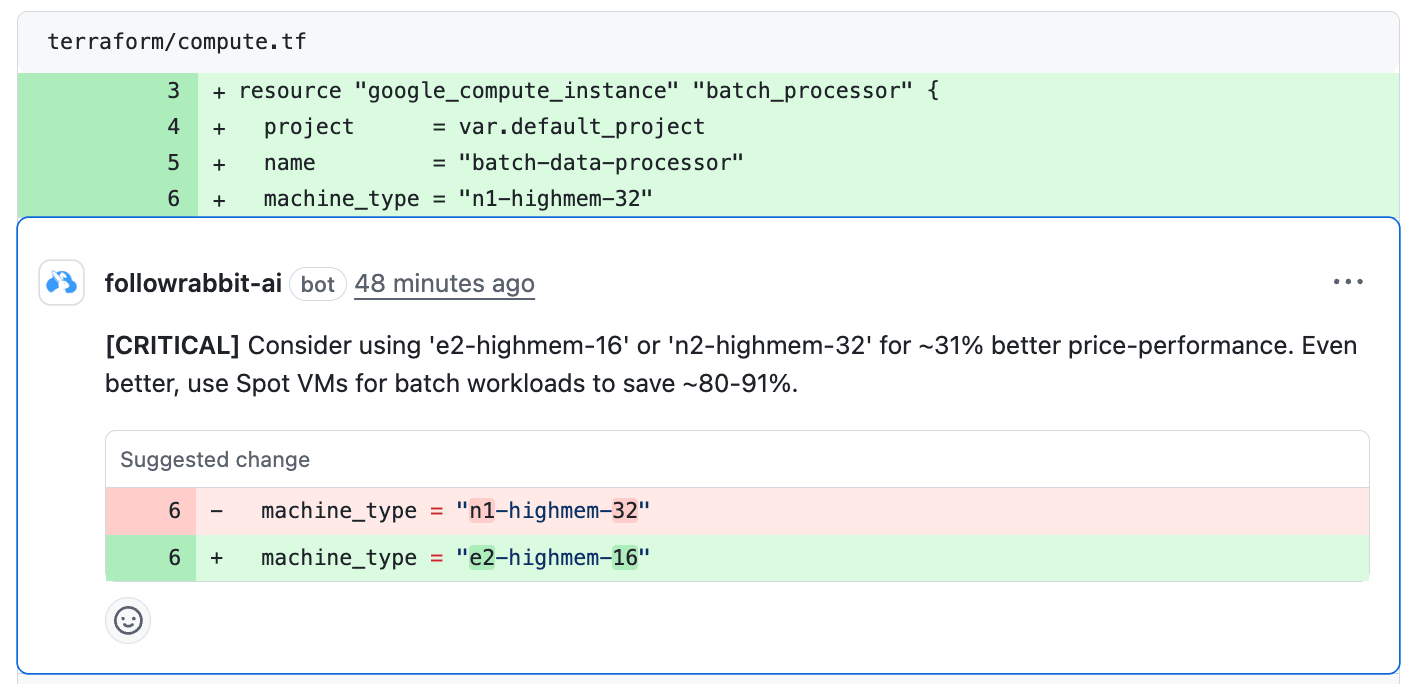
The intent is the same as a strong human review from someone who lives in GCP economics, delivered automatically when the PR opens. Default coverage centers on Terraform, with optional paths for Helm values, Kubernetes manifests and BigQuery SQL depending on configuration.
Context enrichment for coding agents
Coding assistants are fast at generating infra, but they are blind to bill impact and optimization tradeoffs unless you feed them structured context. Context enrichment adds cost-aware, repo-wide analysis into agent workflows: plugins for tools such as Claude Code, Cursor, OpenAI Codex, and GitHub Copilot, plus a CLI that scans local Terraform and returns guidance with paths and line references your agent can apply.
This is not the same as prompting any agent with “follow GCP best practices.” Generic prompts recycle public guidance and whatever fits in the chat window. Rabbit’s context enrichment is built so the model sees your environment: how modules compose, which environments differ, how resources reference each other, and where your repo’s patterns diverge from defaults. The agent gets structured context about your stack, then applies Rabbit’s optimization knowledge on top of that picture.
Unlike a one-off chat prompt, this path is built to read your whole repository layout (modules, environments, repeated patterns), not only the file fragment in the editor, so recommendations stay grounded in how your stack is actually wired.
Applying recommendations
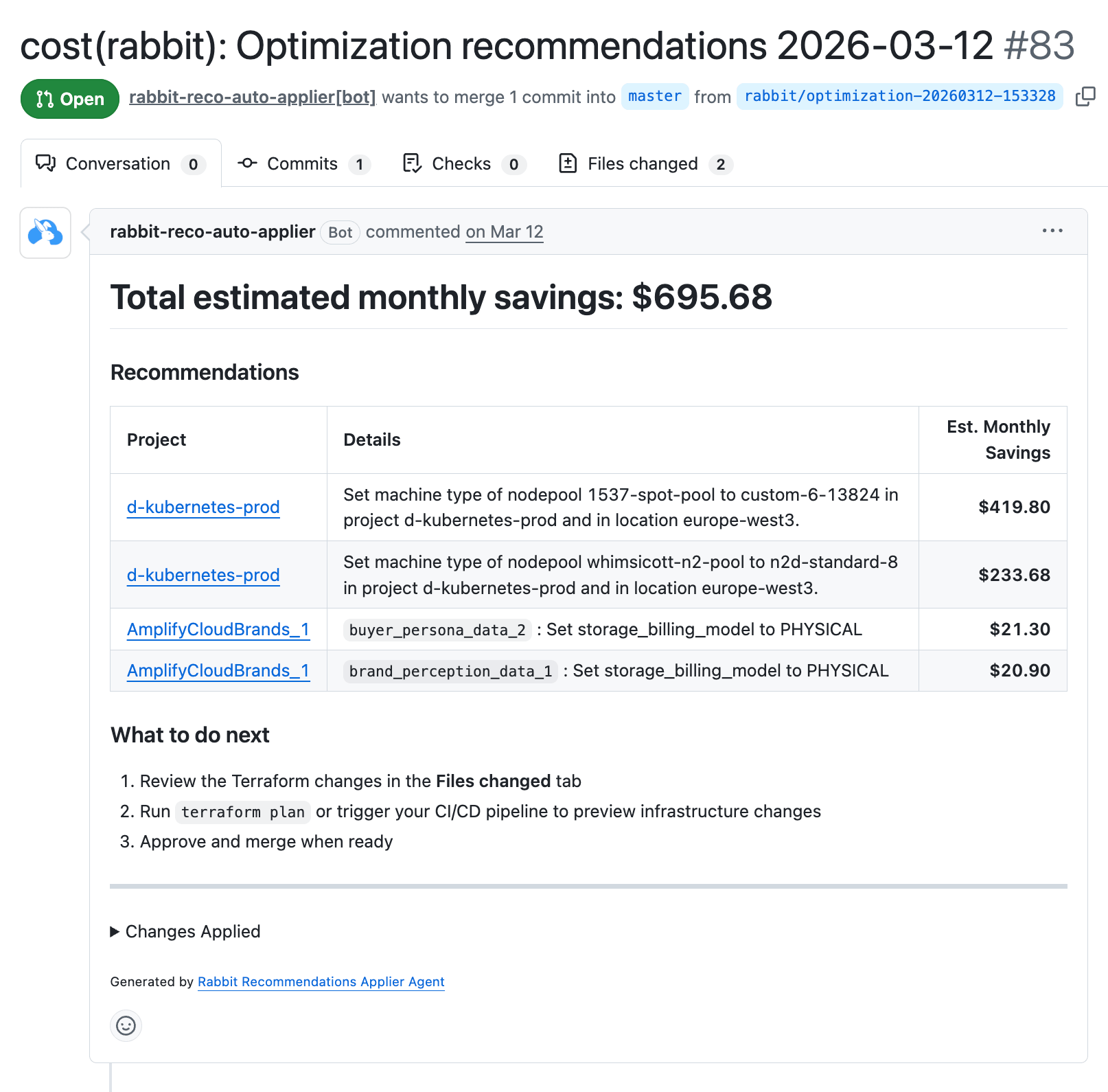
For teams already using the Rabbit platform, Recommendation Applier is the proactive counterpart to PR review. PR review catches new waste in incoming changes; the applier turns existing Rabbit recommendations into ready-to-review pull requests: surgical edits to Terraform (and related IaC) that match your patterns, plus a body that summarizes estimated savings, links back to recommendations, and shows a clear diff.
Delivery can be Rabbit-managed (for example via the same GitHub-centric path you use for reviews) or self-deployed in your own Google Cloud project if you need full control of scheduling, networking, and multi-provider Git.
Where Rabbit Agentic integrates into your toolchain
Once you know the three workflows, the plumbing is intentionally boring: install what matches your team, authenticate once, and let the semantic layer run behind the scenes.
-
The GitHub App is the primary entry for teams that want cost review directly on pull requests: install, select repositories, and reviews attach to the PR timeline your reviewers already use.
-
Agent plugins (Claude Code, Cursor, OpenAI Codex, GitHub Copilot) sit beside your existing agent setup so cost signals show up inside the same loops where code is written and refactored.
-
The
followrabbitCLI (followrabbit costreview) supports local scans and scripted use: extract Terraform from the working tree, send structured context to Rabbit’s API, and feed the response back to a human or an agent as markdown with actionable references.
How Rabbit Agentic is different
Most FinOps tooling focuses on analyzing historical spend (billing, budgets, anomalies). Linters enforce syntax and policy, not dollars. Generic assistants lack infrastructure context and up-to-date information on interconnected pricing mechanics.
Rabbit Agentic targets the development workflow with cost-specific, line-level output and recommendations you can implement before the bill is impacted:
| Billing tools | Static linters | Generic AI | Rabbit Agentic | |
|---|---|---|---|---|
| When | After deployment | Before deploy (syntax and rules) | On request | During code review and development |
| What | What was expensive | Rule violations | General advice | Cost-oriented analysis of infra changes |
| How specific | Service- or project-level | Often file-level | Often vague | File and line references with estimates where possible |
| GCP depth | Shallow for code paths | None for dollars | Generic | Opinionated patterns from specialized optimization work |
| Action | Dashboards and tickets | CI failures | Copy-paste from chat | Inline suggestions, agent-ready blocks, and optimization PRs |
The goal is not another dashboard tab. It is to shift-left cost optimization, making the pull request and the agent session the first place expensive mistakes are caught.
How does Rabbit Agentic work? Under the hood (at a glance)
Rabbit Agentic packages shift-left cost optimization into three concrete workflows that share one semantic layer: PR cost review, agent context enrichment grounded in your repository, and (for Rabbit customers) recommendation-to-PR automation.
- Pull-request review is event-driven: GitHub notifies Rabbit when a relevant pull request changes state; the service fetches the diff, filters to infrastructure files, runs analysis against the semantic layer, then publishes inline findings and a summary.
- Context enrichment follows a scan-then-analyze pattern: the CLI enumerates Terraform resources and module boundaries, sends that structure to the API, and returns structured guidance so an agent can reason across the repo.
- Recommendation Applier pulls pending recommendations from the Rabbit product, maps them to files in your IaC repository, and opens a branch and PR with minimal, pattern-matching edits.
Start from the Rabbit Agentic feature overview to see how each piece fits your team. Ready to get started? Head to the Rabbit Agentic subscription page to start using the free tier with a generous quota (~50 PR reviews).
Want a deeper background on BigQuery reservation economics?
This guide walks through editions, reservations, and practical sizing: